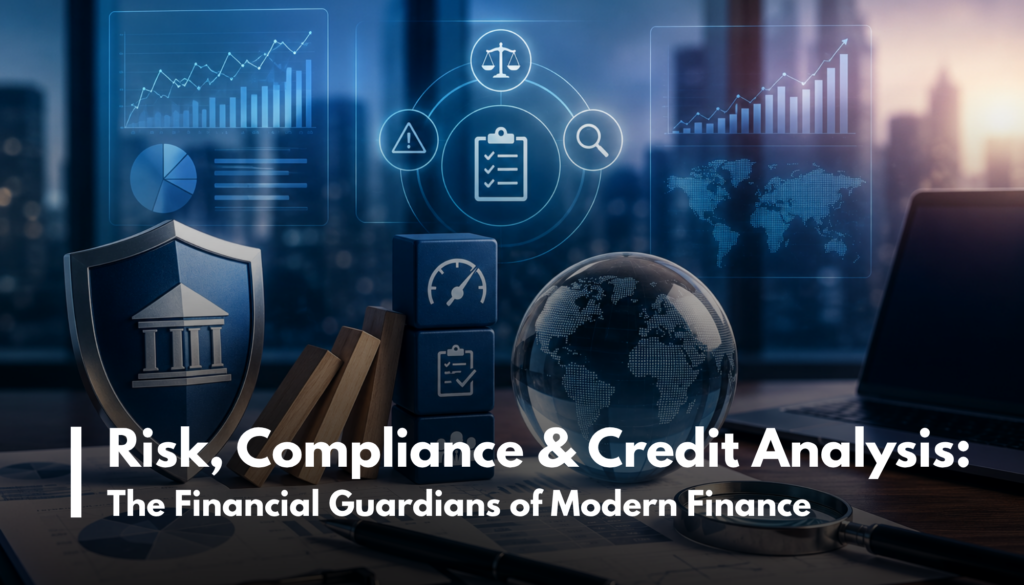
The Invisible Side of Finance That Protects Every Rupee You Invest
When people think of "finance careers", they picture trading floors, IPO bells, and investment bankers in glass boardrooms.
What they don't picture is the person who stops a ₹500 crore loan from being given to a company that will default in 18 months. The team that prevents a bank from being fined ₹200 crore for a compliance breach. Or the internal auditor who quietly uncovers a fraud before it blows up on the front page.
Those people sit in credit, risk, compliance, and internal audit. They're not on the front page. But without them, the rest of finance collapses.
For a commerce graduate who likes being analytical, detail-oriented, and risk-aware, these roles are:
In this article (Part 4 of the "Beyond CA" series), we'll walk through three major career tracks:
We'll also map them to certifications like CIA (Certified Internal Auditor), CMA, and CFA, and show you realistic salary trajectories using 2026 data.

Credit Analysis — Deciding who gets loans and on what terms
When a company applies for a ₹50 crore loan, the bank doesn't just look at its logo and approve it. It hands the file to a credit analyst.
Credit analysts answer three questions:
Day-to-day, credit analysts:
They work in:
2026 data from PayScale, Indeed, 6figr and Indian salary guides shows:
| Experience Level | Typical Salary Range |
|---|---|
| Entry-level (0–2 years) | ₹4–6 LPA in typical banks and NBFCs. Strong profiles at top firms can reach ₹7–8 LPA. |
| Early career (2–4 years) | ₹5–9 LPA range is common. |
| Mid-level (5–9 years) | ₹8–15 LPA average, with top city roles (Mumbai, Bengaluru) crossing ₹18–20 LPA. |
| Senior / Lead roles (10+ years) | ₹15–25 LPA common in large banks. Top performers at global banks and large NBFCs can exceed ₹25–30 LPA. |
6figr's 2026 dataset shows an average total pay of around ₹16.5 LPA across experience levels, with top profiles reported above ₹40 LPA.
Credit analysis is essentially applied financial statement analysis, something BCom students already study. You:
If you naturally enjoy:
…then credit analysis is a very natural, high-impact path.
For credit roles, employers value strong accounting + analytical depth. The most relevant certifications are:
CMA (Certified Management Accountant – US): Deepens your command over cost structures, profitability analysis, variance analysis, and internal controls. Very relevant for understanding whether a borrower's margins and cost base are sustainable.
CFA (Chartered Financial Analyst): Strong on valuation, financial statement analysis, and risk. Particularly useful if you want to grow towards structured credit, corporate banking, or even move later into investment roles.
Most Indian JDs for mid–senior credit roles list CFA, CA, or CMA as "preferred qualifications", especially at foreign banks and large NBFCs.
→ Explore CMA for credit and corporate finance roles
→ Explore CFA if you want to combine credit with investment roles

Risk Management — Building the models and limits that protect banks from financial shocks
Credit risk is just one part of a much bigger picture. Banks, NBFCs, fintechs, and large corporates all manage multiple types of risk:
Risk analysts and risk managers design and run the frameworks that measure and control these risks. They:
Employers include:
Data from PayScale, Glassdoor, 6figr and Indeed indicates:
| Experience Level | Typical Salary Range |
|---|---|
| Entry-level | ~₹3.9–5 LPA average. Junior risk roles in banks sometimes start around ₹3–4 LPA. |
| Early career (1–4 years) | Typical total compensation ₹6–10 LPA. |
| Mid-level (5–9 years) | ₹8–15 LPA common, with 6figr showing averages around ₹15.5 LPA across profiles. |
| Senior / Lead roles | ₹15–25 LPA is realistic for senior analysts and team leads in large banks. Lead or specialised risk roles (e.g., market risk at global banks) can reach ₹30–40+ LPA for top performers. |
Risk profiles tend to pay slightly better than equivalent pure operations roles, reflecting the specialised skills and regulatory importance.
Beyond accounting and finance basics, risk roles increasingly expect:
For market and model risk roles, more advanced quant skills (Python/R, econometrics) are a plus.
Commonly valued credentials include:
Most Indian risk job descriptions mention FRM/CFA/CA; internal audit–heavy roles increasingly prefer CIA.
If your focus is enterprise / operational risk and controls rather than trading-book risk, a combination of CMA + CIA is very powerful.
→ Explore how CIA strengthens risk & internal audit careers

Compliance — Ensuring regulatory rules and internal policies are followed at every step
If risk is about "What could go wrong?", compliance is about "Are we following the rules?"
Compliance officers ensure that banks, NBFCs, brokers, and corporates follow:
Their work includes:
In many organisations, compliance works closely with internal audit and risk management to create an integrated control environment.
Recent 2026 data from PayScale, Indeed, Glassdoor and 6figr shows:
| Experience Level | Typical Salary Range |
|---|---|
| Entry-level | Around ₹4–7 LPA typical. |
| Mid-level | ₹7–15 LPA range across industries. |
| Senior / Lead roles | 6figr reports senior compliance officer averages around ₹18.1 LPA, with common ranges between ~₹17.9–22.9 LPA in their dataset. Glassdoor trajectories show senior/lead roles reaching the ₹20–30+ LPA zone at bigger institutions. |
These numbers vary heavily by sector (BFSI usually pays more than manufacturing) and city (Mumbai, Bengaluru, and Gurgaon pay above national averages).
Compliance checks whether rules are being followed. Internal audit checks whether the rules and controls themselves are designed well and working effectively.
Internal auditors:
They work in:
2026 salary guides show strong demand and clear uplift for certified internal auditors:
| Profile | Salary Insight |
|---|---|
| Internal Auditor (overall) | PayScale shows an average around ₹8.0 LPA, with a range roughly from ₹2.4–20 LPA depending on experience and company size. |
| Triple ICA's 2025–26 guide | Entry (1–3 years): ₹5–7 LPA · Mid-level (4–7 years): ₹7–12 LPA · Senior (8+ years): ₹12–18+ LPA |
| CIA-certified professionals | Triple ICA and Eduyush report that CIAs often start around ₹5–8 LPA as freshers, rising to ₹8–15 LPA with 3–5 years' experience, and ₹15–30+ LPA at senior levels in BFSI and consulting. |
| Senior leadership (CIA) | Eduyush's 2026 guide notes that CIA-certified professionals in India can eventually reach total packages in the ₹50L+ to ₹1 crore range at senior leadership and BFSI risk/compliance roles. 6figr data for senior internal auditors shows averages around ₹21 LPA, with ranges up to ₹40+ LPA in their profiled sample. |
The pattern is clear: CIA and strong experience significantly lift ceilings compared with non-certified peers.

CIA — The only globally recognised qualification dedicated specifically to internal audit
The Certified Internal Auditor (CIA) is the only globally recognised professional qualification dedicated specifically to internal audit, awarded by The Institute of Internal Auditors (IIA).
It validates your skills in:
Key points from 2026 guides by IIA partners and Indian training providers:
Three exam parts:
Exam format: Computer-based MCQs; 3 parts with 100–125 questions each.
Duration: Many candidates complete within 6–12 months with focused study.
Cost: Total costs (IIA membership, exam fees, training) typically in the USD 800–1,000 range (~₹65–85k, excluding coaching), depending on membership category and chosen study materials.
Eligibility: Generally requires a bachelor's degree plus 1–2 years of relevant experience (the exact experience requirement varies with education level) and adherence to IIA's Code of Ethics.
CIA is ideal if you want to build a career in:
Compared with a generalist credential like CA, CIA is narrower but deeper in audit and controls. It signals to employers that you are a specialist in how organisations manage risk and ensure integrity of their processes, not just their accounting.
→ Explore IFCPLTD's CIA coaching pathway
Deep controls & audit rigor (CIA) plus strong cost, performance and business finance understanding (CMA). That combination is very attractive for Head of Internal Audit, Chief Risk Officer, and Compliance Head tracks.

Comparing credit, risk, compliance, and internal audit — based on 2026 data and typical career paths in India
To make this concrete, here's a simplified comparison based on 2026 data and typical career paths in India:
| Dimension | Credit Analysis | Risk Management | Compliance & Internal Audit |
|---|---|---|---|
| Primary Question | "Should we lend?" | "What could go wrong?" | "Are we following rules & are controls working?" |
| Typical Employers | Banks, NBFCs, rating agencies | Banks, NBFCs, fintechs, large corporates | Banks, insurers, brokers, large corporates, Big 4 |
| Entry Salary (0–2 yrs) | ₹4–6 LPA (up to ~₹7–8L at top firms) | ₹4–6 LPA | Compliance: ₹4–7 LPA; Internal audit: ₹5–7 LPA |
| Mid-Level (5–9 yrs) | ₹8–15 LPA (top city roles up to ~₹18–20L) | ₹8–15 LPA (specialist roles higher) | Compliance: ₹7–15 LPA; Internal audit: ₹7–12+ LPA |
| Senior (10+ yrs) | ₹15–25+ LPA | ₹15–25+ LPA (lead roles ₹30–40L) | Senior compliance/internal audit often ₹15–30+ LPA; leadership can reach ₹40L+ |
| Work Intensity | Moderate peaks around big lending decisions | Ongoing but spiky around regulatory deadlines | Cyclical (audit/compliance cycles), generally manageable |
| Best Fit Personality | Analytical, detail-focused, likes company analysis | Risk-aware, systems thinker, comfortable with models | Detail-obsessed, principled, comfortable challenging processes |
| Core Tools | Excel, financial statements, covenants | Excel, SQL, risk models, dashboards | Audit software, Excel, policy frameworks |
| Key Certifications | CMA, CFA | CFA, FRM, CMA | CIA, CMA (plus CA/CPA for some roles) |
These figures are indicative ranges based on aggregated 2026 data; actual offers vary by firm, city, and profile.
Ask yourself these questions:
1. Do you enjoy deep dives into company financials?
2. How comfortable are you being the one who says "No"?
These careers often involve saying "no" to business teams:
If you're comfortable holding that line, you'll likely enjoy these roles.
3. Do you want a more technical/quant flavour or a process/control flavour?
4. What kind of leadership role do you aspire to?
5. Work-Life and Stability Preferences
If you want relatively stable hours and high job security, these three tracks are much more sustainable than front-office trading or investment banking. Banks and regulators treat risk, compliance and audit as non-negotiable functions, which helps during downturns.

Your roadmap — how a commerce student can practically move into these roles over 5 years
Here's how a commerce student or young professional can practically move into these roles.
Start reading:
Decide your direction:
Depending on your direction:
If you lean towards Internal Audit / Compliance / Controls:
If you lean towards Credit / Corporate Risk:
If you're interested in market/treasury risk later:
Take on projects that face senior stakeholders:
If you started with CMA, consider adding CIA later for a double-strength profile in performance + controls.
₹12–20 LPA in credit or risk ₹12–18+ LPA in internal audit/compliance, higher if CIA-certified and in BFSI or Big 4.
If you decide that credit, risk, compliance, or internal audit is your lane, the right certification and training can compress your learning curve by years.
At IFCPLTD, your most relevant pathways would be:
Our programs typically combine:
You can start with one credential aligned to your immediate career goal, then layer others as you grow.
Within serious financial institutions, yes. These teams sit close to management and regulators. You may not get Instagram glamour, but internally, CROs, Heads of Risk, and Heads of Internal Audit are critical voices at the table.
Often yes. Internal auditors build a cross-functional view of the organisation. Many transition into operations leadership, risk leadership, controller roles, or even CFO track, especially when they pair CIA with CMA/CA.
Not to start. If you're sure you love audit/controls, CIA is the priority. If you want broader corporate finance or credit exposure, CMA first makes sense. Later in your career, having both is extremely powerful for senior GRC or CFO-type roles.
For basic risk analyst roles, strong Excel plus some SQL is usually enough. For more advanced market risk/model risk roles, Python/R and statistical modelling are a big advantage, but you can learn them over time.
AI will automate data extraction and basic testing, but it raises the bar for human judgement on complex risks, controls design, and ethical calls. Roles will shift toward higher-level analysis and interpretation rather than disappear.
Yes. Credit, risk, and internal audit are very friendly to analytical introverts. You'll still need to communicate clearly in meetings and reports, but the roles don't demand the extroverted client-facing intensity of sales or IB.
If Article 1 showed you there's more to finance than CA, Article 4 should show you this:
Finance isn't just about making money. It's also about protecting it.
And for the right commerce graduate, being the guardian can be just as rewarding as being the rainmaker.

You're staring at your degree certificate. Four years of commerce courses are behind you, and now comes the decision that'll...
Read More
Every year, a growing number of graduates and working professionals ask the same question: "I want a career in audit...
Read More
The "People" Side of Finance — Where Numbers Meet Relationships and Teaching By now in this series, you've seen the...
Read More
The Careers Where You Get Paid to Think About Money All Day If Investment Banking & Corporate Finance: High-Stakes Careers...
Read More
Risk, Compliance and Credit Analysis: The Financial Guardians of Modern Finance The Invisible Side of Finance That Protects Every Rupee...
Read More
The Two Paths That Turn Your BCom Into ₹20+ Lakh Careers—And How to Pick the Right One If you read...
Read More
"CA, right?" Wrong. Your Commerce Degree Opens 10+ Doors—Here's What Nobody Tells You Every commerce student gets asked the same...
Read More
What is the CFA salary in India in 2026? CFA salary in India ranges from ₹4–6 LPA at entry level...
Read More
CFA and AI: Will Robots Replace Finance Professionals or Just the Unskilled Ones? If you’re a B.Com student looking...
Read More
In today’s interconnected world, the demand for globally recognized financial professionals is at an all-time high. Among the top certifications...
Read More
Is the demand for CIA USA increasing rapidly in 2025? Global finance is constantly evolving, and the CIA (Certified Internal...
Read More
Looking for an Academy that helps you boost your career in financial management? In the world of finance and accounting,...
Read More
What are the skills that help boost your career in CMA USA? Absolutely a great question and one we hear...
Read More
In today’s dynamic and globally interconnected financial ecosystem, leadership in finance demands more than just technical expertise. It calls for...
Read More
In today’s fast-paced and competitive business world, professionals in finance and accounting must possess more than just a degree. Specialized...
Read More
Becoming a Certified Public Accountant (CPA) US is a prestigious achievement that opens doors to a wide range of accounting...
Read More
When it comes to choosing between pursuing CMA USA and a MBA in Finance, the decision largely depends on your...
Read More
Corporate Governance has become critical to sustaining investor confidence, ensuring compliance, and enhancing organizational performance. The Certified Internal Auditor (CIA)...
Read More
In today’s interconnected world, professional qualifications that are globally recognized can open up vast career opportunities, especially for Indian students...
Read More
We all heard about the Certified Management Accounting (CMA US) course from the Institute of Management Accountants (IMA). It is...
Read More
If you are in search of a professional financial qualification after your graduation (B-com) OR if you want to certify...
Read More
Are you…… A fresher after your Graduation? An experienced person working in the finance domain without a professional qualification? Interested...
Read More
What is CMA(US) CMA is know as Certified Management Accountant. Every country has a Management Accounting course which ensures that...
Read More
These has always been an important point in the minds of learners. How to choose the right training partner? How...
Read More
About IPFC Academy IPFC Academy has been providing quality CMA(US) training since 2010 and is one of the first institute...
Read More
What is CMA? CMA stands for Certified Management Accountant. This qualification is an approved professional qualification from International Federation of...
Read More
What is US CPA current structure The CPA USA is a very popular professional qualification. In fact, this qualification enjoys...
Read More
Ever since CPA US has opened its exam center in India (2020), the demand for CPA US has increased many...
Read More
What is CMA US ? CMA stands for Certified Management Accountant. This qualification is an approved professional qualification from International...
Read More
What is CMA USA CMA USA (Certified Management Accountant) is a professional certification that demonstrates mastery in management accounting and...
Read More
In the ever-evolving landscape of the financial industry, professionals seek qualifications that not only validate their expertise but also propel...
Read More
Introduction Becoming a Certified Public Accountant (CPA) in the United States is a prestigious achievement that opens doors to rewarding...
Read More
What is CPA? CPA stands for Certified Public Accountant. This qualification is an approved professional qualification from International Federation of...
Read More
You’re staring at your degree certificate. Four years of commerce courses are behind you, and now comes the decision that’ll…

Professional counselling to help you with career and course choices
Schedule a Live Session