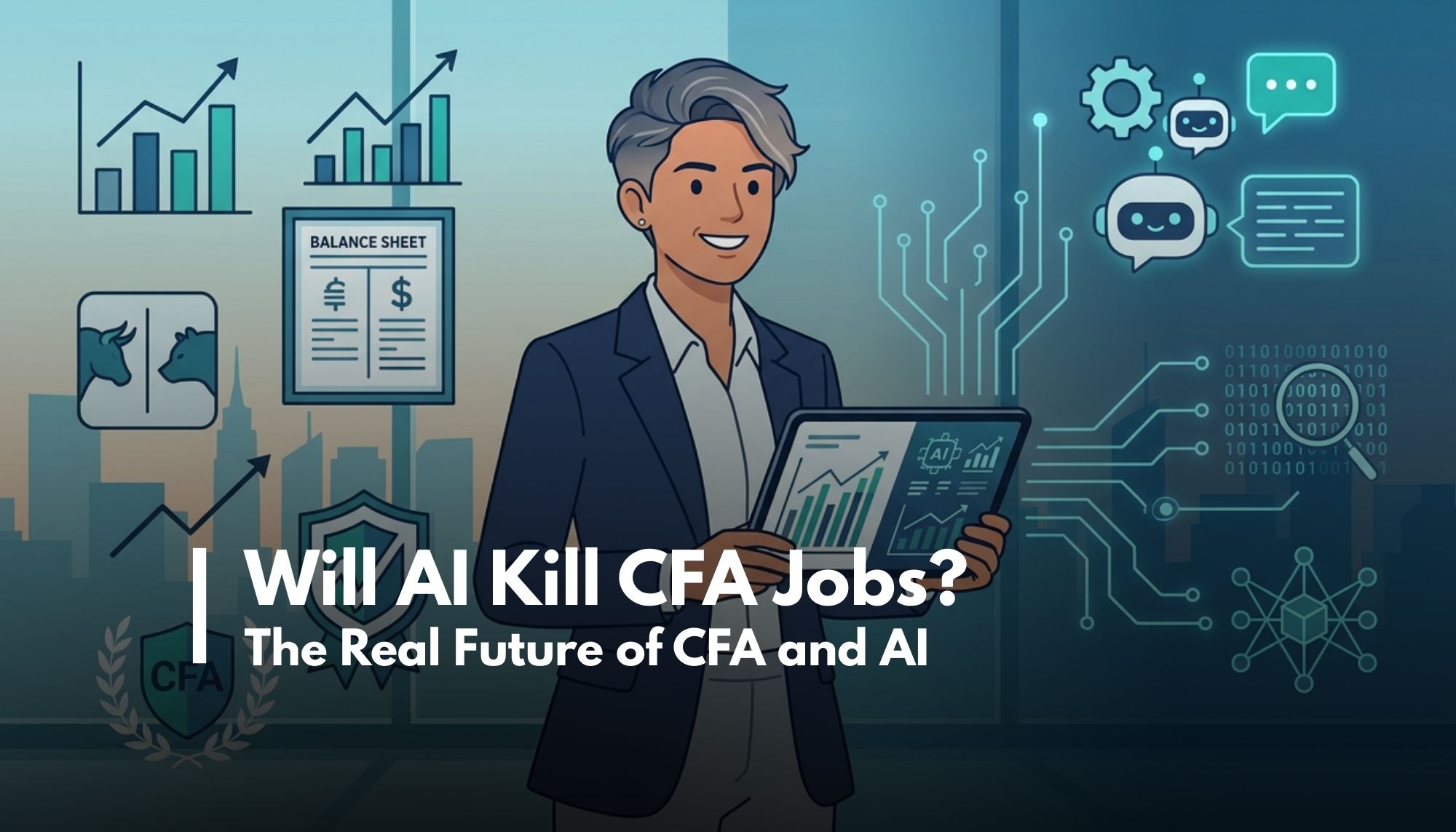
“Bro, AI will do all the analysis. CFA jobs won’t even exist.”
Let’s pause.
Is that actually true? Or is what’s really happening this:
AI will replace repetitive finance work. AI will not replace skilled finance professionals who know how to use it.
In this article, we’ll unpack the real relationship between CFA and AI, what global data says about future finance jobs, and how you can position yourself on the right side of the change – not under it.
And yes, we’ll also talk about how a CFA course that teaches you AI (instead of ignoring it) can give you an unfair advantage.
Let’s start with facts, not fear.
The CFA Institute – the body that actually runs the CFA Program – has been studying how AI is changing finance roles. Their research shows a clear pattern:
AI is already automating routine tasks like reconciliations, data entry and standard reporting in finance.
As these repetitive tasks disappear, early‑career professionals are moving towards higher‑value work: financial planning, risk management, portfolio strategy and advisory roles.
In other words: AI is changing what junior finance professionals do, not deleting them.
So the question after B.Com is no longer:
“Will AI take CFA jobs?”
The real question is:
“Will CFA professionals who ignore AI lose out to those who embrace it?”
You might have seen headlines: “ChatGPT can pass the CFA exam.”
CFA Institute itself has addressed this. Large language models (LLMs) can indeed perform surprisingly well on certain types of CFA questions, especially theory and calculation‑oriented ones. That’s impressive – but it doesn’t tell the full story.
Here’s what those same analyses point out:
AI can answer questions, but it doesn’t own responsibility for real‑world decisions or client money.
AI has no ethics, no skin in the game, and no regulatory accountability. The CFA Program, on the other hand, is built around ethics, judgment and fiduciary responsibility.
AI is brilliant with patterns and data, but it still struggles with context, nuance and long‑term accountability – all crucial in investment decisions.
CFA Institute’s own research on AI and unstructured data repeatedly emphasises that the future of investment work is about AI + human intelligence, not AI instead of humans. Investment professionals are already using tools like ChatGPT to speed up research and analysis – but humans still make the final calls.
So yes, AI might “pass” the CFA exam on a screen. But no, that does not mean it can replace the role of a trusted, accountable CFA professional advising clients and institutions.
It’s not just CFA Institute saying this.
The World Economic Forum’s Future of Jobs Report 2025 makes two things crystal clear:
By 2030, an estimated 170 million jobs will be created and 92 million displaced globally – around 22% of today’s roles will either disappear or be reinvented.
In finance, the roles that are growing are strategic finance roles: financial analysts, risk and compliance specialists, commercial finance leaders, investment and advisory professionals.
In other words, the roles closest to CFA‑type profiles – analytical, strategic, judgment‑heavy finance jobs – are actually expected to grow, not vanish.
What’s shrinking are:
Purely operational roles
Jobs that are mostly about moving data around instead of interpreting it
Repetitive middle‑office tasks that AI and automation can perform faster and cheaper
That should be good news for you if you’re aiming for serious finance careers after B.Com.
But there’s a catch.
Major consulting and research firms are aligned on one major point:
AI will massively increase productivity and value in banking and financial services.
For example:
A McKinsey analysis suggests generative AI could add $200–340 billion in value per year to the banking sector alone.
Another McKinsey study cited in multiple industry summaries estimates AI could add up to $1 trillion annually to global banking profits.
Where does that money come from?
Automating low‑value work
Making decisions faster with better data
Allowing teams to do more with fewer people
The CFA Institute Graduate Outlook Survey also notes that employers now want “hybrid skillsets” that combine:
Traditional financial analysis
Data science and programming (Python, R)
AI literacy and comfort working with analytics tools
Plus soft skills: communication, critical thinking, adaptability
So here is the brutal truth:
AI is not going to kill the CFA profile. AI is going to kill the CFA profile that stops learning after the exam.
If you get the CFA letters but still work like it’s 2010 – manually pulling data, not using AI tools, not understanding how models work – you are exactly the kind of professional AI will replace or undercut.
If, on the other hand, you have:
A CFA‑level understanding of finance
A working knowledge of AI tools and data workflows
The ability to question, interpret and challenge AI outputs
…you are suddenly in the small group of people the market really wants.
Let’s answer this directly.
If by “CFA” you mean:
Memorising formulas
Passing exams
Then expecting a job because of three letters on your CV
→ That version of CFA is dying.
But if by “CFA” you mean:
Building a deep foundation in investment analysis, ethics and portfolio management
Learning to think like an analyst or future CFO who uses AI and data tools to augment judgment
Positioning yourself for roles that sit closer to decision‑making and capital allocation
→ That version of CFA is not just alive, it’s becoming more valuable.
CFA Institute itself has started integrating practical skills modules into the program, including Python, data analysis and AI‑related topics at different levels. Their own messaging is clear: finance careers are moving towards AI‑enabled, data‑driven decision‑making, and professionals need to adapt.
For a B.Com student in India thinking about core finance roles – equity research, portfolio management, corporate finance, FP&A, risk, or even future CFO roles – the right question is:
“How can I combine CFA and AI to make myself hard to replace?”
Look at how global finance leadership roles are evolving.
Commentary on the Future of Jobs Report aimed at finance leaders highlights that:
Finance is moving “up the value chain” – less about reporting history, more about shaping decisions.
AI produces faster data. Finance leaders interpret risk, make trade‑offs, and advise boards and founders.
The most effective CFOs today combine:
Strong commercial judgment
Comfort with technology and data
The ability to influence stakeholders
Calm decision‑making under pressure
Hiring a CFO who doesn’t understand AI and modern data tools is going to look as strange in a few years as hiring a CFO today who cannot use Excel.
That’s why building your career early with a combination of:
Core finance knowledge (through paths like CFA, CMA, CPA, CIA)
AI literacy and data‑driven thinking
Communication and leadership skills
…makes you a much more serious candidate for these future roles.
If you are in B.Com or just finished it, here’s a practical path:
Decide if you really want core finance. If you’re excited by markets, analysis, valuation, risk and long‑term investing, CFA is a natural fit.
Accept that AI is part of the job, not a side topic. Read at least one credible article per week on AI in finance from sources like CFA Institute or respected finance publications.
Use AI tools in your learning, not just your entertainment. Start using tools like Perplexity or ChatGPT for:
Summarising company reports
Generating practice questions from CFA topics
Drafting investment theses that you then manually double‑check This is exactly how many current investment professionals are already using generative AI.
Pick a CFA course that acknowledges AI – not hides from it. A course that only teaches you old‑school theory without touching AI, Python, or data orientation is already lagging behind employers’ expectations.
At IPFC, for example, we designed our AI‑Powered CFA Launchpad for exactly this reason: to combine CFA Level I prep with an AI Finance Lab and an Investment Career Foundation Program, so students learn both the curriculum and how to work with modern tools and hiring expectations.
You don’t need an “AI” label slapped on everything.
You need specific, practical AI skills that fit into the workflows finance professionals actually use.
Research from CFA Institute on AI and unstructured data shows that finance professionals are already using generative AI heavily for:
Research and information gathering
Writing assistance
Knowledge extraction and summarisation
Financial and investment tasks and coding
Similarly, articles aimed at financial analysts show how AI can:
Automatically collect and clean data from multiple sources
Identify patterns and risks faster than humans alone
Free analysts from repetitive work so they can focus on strategy and decision‑making
So a good CFA and AI preparation journey should realistically help you:
Understand where AI fits in investment research, portfolio management and risk analysis
Treat AI as a power tool – helpful but requiring human control, verification and ethical judgment
Use AI to boost your productivity in studying and in your eventual job
If your CFA training acknowledges this reality, you’re aligning yourself with where the industry is clearly heading.
If you only remember one line from this article, make it this:
AI is not coming for all CFA professionals. AI is coming for CFA professionals who refuse to learn AI.
The world of finance is not moving away from human decision‑makers. It is moving towards human decision‑makers who are amplified by AI.
For you as a B.Com graduate exploring finance careers, that means:
The CFA credential is still one of the strongest ways to build deep finance expertise.
The CFA and AI combination is what will make you stand out in a crowded job market.
Employers will increasingly value finance professionals who can read the numbers, ask the right questions, and use AI tools responsibly.
If you’re considering this path and want to see what a modern, AI‑aware CFA program looks like in practice, learn more about the IPFC AI‑Powered CFA Launchpad.
AI will automate routine finance tasks like reconciliations, data entry and basic reporting, but research from CFA Institute indicates it is transforming, not eliminating, graduate roles in finance. Entry‑level professionals will spend less time on repetitive work and more on judgment‑driven tasks such as planning, risk, and advisory – areas where CFA skills are directly relevant.
Yes. Global reports such as the World Economic Forum’s Future of Jobs highlight growth in strategic finance roles like financial analysts, risk specialists and commercial finance leaders. These roles increasingly require both deep finance knowledge and comfort with AI and data tools, making a CFA + AI skillset highly valuable.
CFA Institute’s research on unstructured data shows investment professionals already use generative AI for research, summarisation, coding and investment tasks. As a CFA student, you can use tools like Perplexity or ChatGPT to summarise reports, generate practice questions, and draft investment theses – provided you always verify outputs and maintain ethical standards.
Given that employers now seek “hybrid skillsets” combining financial analysis with data and AI literacy, choosing a CFA course that integrates AI tools and workflows into the learning process can give you a clear advantage. It aligns your training with how finance work and hiring expectations are evolving.
Future‑of‑work analysis shows finance leadership roles are shifting from reporting history to shaping strategic decisions, with growing emphasis on analytical thinking, resilience and comfort with technology. A CFA background, combined with AI literacy and strong communication skills, can build a solid foundation for such roles over time.
You're staring at your degree certificate. Four years of commerce courses are behind you, and now comes the decision that'll...
Read More
Every year, a growing number of graduates and working professionals ask the same question: "I want a career in audit...
Read More
The "People" Side of Finance — Where Numbers Meet Relationships and Teaching By now in this series, you've seen the...
Read More
The Careers Where You Get Paid to Think About Money All Day If Investment Banking & Corporate Finance: High-Stakes Careers...
Read More
Risk, Compliance and Credit Analysis: The Financial Guardians of Modern Finance The Invisible Side of Finance That Protects Every Rupee...
Read More
The Two Paths That Turn Your BCom Into ₹20+ Lakh Careers—And How to Pick the Right One If you read...
Read More
"CA, right?" Wrong. Your Commerce Degree Opens 10+ Doors—Here's What Nobody Tells You Every commerce student gets asked the same...
Read More
What is the CFA salary in India in 2026? CFA salary in India ranges from ₹4–6 LPA at entry level...
Read More
CFA and AI: Will Robots Replace Finance Professionals or Just the Unskilled Ones? If you’re a B.Com student looking...
Read More
In today’s interconnected world, the demand for globally recognized financial professionals is at an all-time high. Among the top certifications...
Read More
Is the demand for CIA USA increasing rapidly in 2025? Global finance is constantly evolving, and the CIA (Certified Internal...
Read More
Looking for an Academy that helps you boost your career in financial management? In the world of finance and accounting,...
Read More
What are the skills that help boost your career in CMA USA? Absolutely a great question and one we hear...
Read More
In today’s dynamic and globally interconnected financial ecosystem, leadership in finance demands more than just technical expertise. It calls for...
Read More
In today’s fast-paced and competitive business world, professionals in finance and accounting must possess more than just a degree. Specialized...
Read More
Becoming a Certified Public Accountant (CPA) US is a prestigious achievement that opens doors to a wide range of accounting...
Read More
When it comes to choosing between pursuing CMA USA and a MBA in Finance, the decision largely depends on your...
Read More
Corporate Governance has become critical to sustaining investor confidence, ensuring compliance, and enhancing organizational performance. The Certified Internal Auditor (CIA)...
Read More
In today’s interconnected world, professional qualifications that are globally recognized can open up vast career opportunities, especially for Indian students...
Read More
We all heard about the Certified Management Accounting (CMA US) course from the Institute of Management Accountants (IMA). It is...
Read More
If you are in search of a professional financial qualification after your graduation (B-com) OR if you want to certify...
Read More
Are you…… A fresher after your Graduation? An experienced person working in the finance domain without a professional qualification? Interested...
Read More
What is CMA(US) CMA is know as Certified Management Accountant. Every country has a Management Accounting course which ensures that...
Read More
These has always been an important point in the minds of learners. How to choose the right training partner? How...
Read More
About IPFC Academy IPFC Academy has been providing quality CMA(US) training since 2010 and is one of the first institute...
Read More
What is CMA? CMA stands for Certified Management Accountant. This qualification is an approved professional qualification from International Federation of...
Read More
What is US CPA current structure The CPA USA is a very popular professional qualification. In fact, this qualification enjoys...
Read More
Ever since CPA US has opened its exam center in India (2020), the demand for CPA US has increased many...
Read More
What is CMA US ? CMA stands for Certified Management Accountant. This qualification is an approved professional qualification from International...
Read More
What is CMA USA CMA USA (Certified Management Accountant) is a professional certification that demonstrates mastery in management accounting and...
Read More
In the ever-evolving landscape of the financial industry, professionals seek qualifications that not only validate their expertise but also propel...
Read More
Introduction Becoming a Certified Public Accountant (CPA) in the United States is a prestigious achievement that opens doors to rewarding...
Read More
What is CPA? CPA stands for Certified Public Accountant. This qualification is an approved professional qualification from International Federation of...
Read More
You’re staring at your degree certificate. Four years of commerce courses are behind you, and now comes the decision that’ll…
Professional counselling to help you with career and course choices
Schedule a Live Session