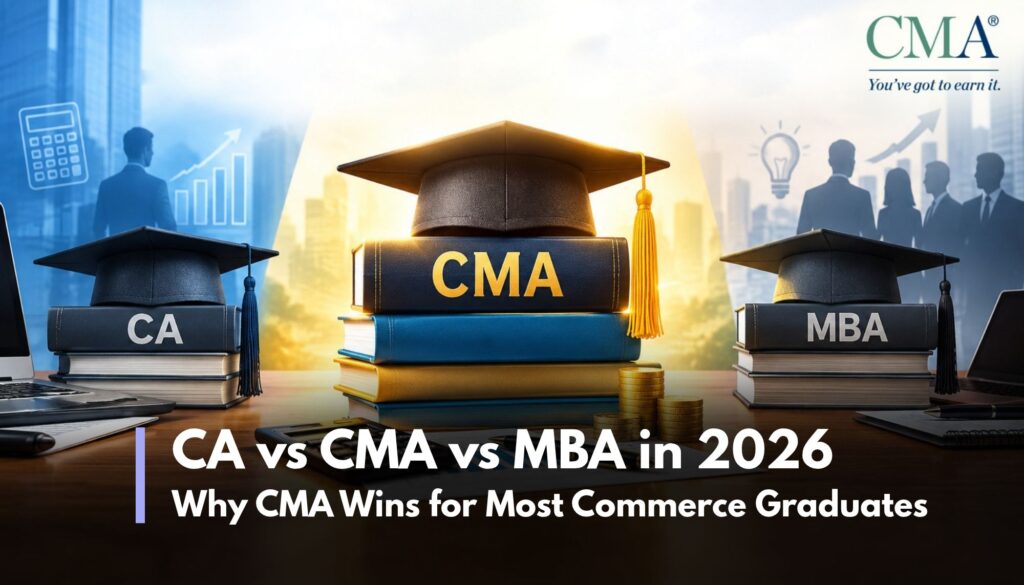
You're staring at your degree certificate. Four years of commerce courses are behind you, and now comes the decision that'll shape the next 5 to 10 years of your career: CA, MBA, or CMA? All three are legitimate. All three promise financial security and growth. But they differ enormously in cost, duration, and how fast they actually get you earning — and for most commerce graduates weighing speed, cost, and global relevance together, CMA comes out ahead. Here's the honest breakdown of why, along with where CA and MBA still make sense.
Look at that table closely: CMA is the only path that combines a short timeline, low cost, a reasonable pass rate, and the ability to earn while you study. That combination is exactly why it's become the default recommendation for commerce graduates who want results without years of financial strain.
There are two versions of this certification — CMA India (ICMAI) and US CMA (IMA) — and understanding both is the first step to picking the right one for your goals.
Covers cost accounting, financial management, strategic management, and risk analysis across Foundation, Intermediate, and Final stages. There's no compulsory articleship — just 8 weeks of practical training spread across the course. BCom graduates can skip Foundation and finish in roughly 2.5 to 3 years, at a total cost of around Rs. 54,100 (Intermediate + Final combined) plus optional coaching. CMA India has a strong presence in manufacturing and PSUs, where it's highly valued for cost control and FP&A roles. Freshers typically earn Rs. 5 to 8 LPA (PSUs offer Rs. 17 to 26 LPA to toppers), rising to Rs. 15 to 25 LPA by 3 to 5 years, and Rs. 50 to 70 LPA+ at the CFO/Controller level.
Just two exams — Part 1: Financial Planning, Performance & Analytics; Part 2: Strategic Financial Management — and a pass rate of 40 to 50% globally, far higher than CMA India or CA. Most candidates finish in 6 to 18 months, often while working full-time, since requirements are simply a bachelor's degree in any discipline plus 2 years of relevant work experience. Entry-level US CMAs in India earn Rs. 6 to 10 LPA, mid-level (3 to 7 years) Rs. 15 to 25 LPA, and senior Controllers or Finance Directors Rs. 25 to 50 LPA or more, with Big 4 firms and GCCs paying toward the top of these bands. We've covered the full salary breakdown, employer list, and career paths in detail in Why CMA USA Is the Smartest Career Move for Finance and Accounting Professionals in 2026.
Recognised in 100+ countries, US CMA is what positions you for multinational roles — if you're not sure which of the two versions fits your plans, our dedicated comparison walks through it in full: Difference between CMA India & CMA USA.
For a deeper look at exactly which skills make the biggest difference once you're certified, read Skills that advanced your career in CMA USA. And if you're weighing how far this credential can actually take you geographically, see Global Opportunities for CMA USA Holders: Where Can You Work?
CA remains unmatched for deep statutory expertise — audit, tax, and compliance work that every Indian company legally requires. The trade-off is a 4.5 to 5 year journey through Foundation, Intermediate, Final, and a 3-year articleship paying Rs. 5,000 to 15,000 a month, with 2026 pass rates ranging from roughly 19 to 20% at Foundation down to as low as 11% at Final in some sessions. Freshers earn Rs. 6 to 9 LPA, growing to Rs. 8 to 15 LPA by Year 5 and Rs. 30 to 70 LPA at the CFO or partner level over a decade or more. Choose CA if you want independent practice potential, deep technical depth, and can commit to the long grind — and if you're exploring other finance-adjacent careers beyond the obvious CA route, Beyond CA: 10 Finance Careers Every Commerce Student Should Know About is worth a read.
An MBA from a genuinely Tier 1 school (IIM, XLRI, ISB) can mean a Rs. 15 to 25 LPA starting salary in consulting or investment banking, growing to Rs. 30 to 50 LPA by Year 5. But the cost is steep — Rs. 17 to 45 lakhs — and entirely dependent on clearing a competitive entrance exam with roughly a 10% success rate at top IIMs. An MBA from a Tier 2 or unranked college can cost Rs. 8 to 20 lakhs while landing a starting salary barely better than a CA or CMA fresher who spent a fraction of that. Choose MBA only if you've genuinely cleared a Tier 1 entrance and want broad exposure to strategy and leadership beyond finance specifically.
Key insight: CMA reaches a strong Year 5 salary at roughly one-tenth the cost of a Tier 1 MBA, and without the multi-year unpaid grind that CA requires. Only a genuinely top-tier MBA outearns it by Year 5 — and that outcome depends entirely on clearing an entrance exam that roughly 90% of candidates don't.
If CMA is the path you're leaning toward — and for most commerce graduates weighing cost, speed, and global relevance, it is — IPFC Academy's CMA USA course is built specifically to get you there without wasted time:
New to the exam itself and want a step-by-step starting point? How to prepare for CMA US walks through exactly how to begin.
Because it's the only one of the three that combines a short timeline (as little as 6 to 18 months for US CMA), low cost (a fraction of an MBA), a reasonable pass rate, and the ability to earn a real salary while you study. CA takes nearly 5 years with an unpaid articleship, and MBA's high returns depend entirely on clearing a competitive entrance exam.
If you're targeting domestic manufacturing, PSUs, or cost-control roles, CMA India fits well. If you want global recognition, a higher pass rate, and are building toward multinational or GCC roles, US CMA is the stronger choice. See our full breakdown in Difference between CMA India & CMA USA.
Yes — this is one of CMA's biggest advantages. With no compulsory unpaid articleship and on-demand exam scheduling (for US CMA), most candidates prepare part-time while continuing to work, which is exactly what IPFC Academy's weekend and after-hours live classes are built around.
Often, yes. CA gives you deep statutory and compliance expertise; CMA adds strategic financial management and management accounting skills. Together, this combination is increasingly valued by employers and can accelerate movement into CFO-track roles.
CMA is built for strategic finance, not audit. If governance, risk, and internal audit are what draw you, CIA (Certified Internal Auditor) is the purpose-built credential for that path — see Why CIA USA Is the Audit Certification Leading Companies Across Every Industry Are Racing to Hire For for the full picture.
Ready to start your CMA journey?
Explore the IPFC Academy CMA USA Courseor reach out at +91-9903100338 to speak with a counsellor.
You're staring at your degree certificate. Four years of commerce courses are behind you, and now comes the decision that'll...
Read More
Every year, a growing number of graduates and working professionals ask the same question: "I want a career in audit...
Read More
The "People" Side of Finance — Where Numbers Meet Relationships and Teaching By now in this series, you've seen the...
Read More
The Careers Where You Get Paid to Think About Money All Day If Investment Banking & Corporate Finance: High-Stakes Careers...
Read More
Risk, Compliance and Credit Analysis: The Financial Guardians of Modern Finance The Invisible Side of Finance That Protects Every Rupee...
Read More
The Two Paths That Turn Your BCom Into ₹20+ Lakh Careers—And How to Pick the Right One If you read...
Read More
"CA, right?" Wrong. Your Commerce Degree Opens 10+ Doors—Here's What Nobody Tells You Every commerce student gets asked the same...
Read More
What is the CFA salary in India in 2026? CFA salary in India ranges from ₹4–6 LPA at entry level...
Read More
CFA and AI: Will Robots Replace Finance Professionals or Just the Unskilled Ones? If you’re a B.Com student looking...
Read More
In today’s interconnected world, the demand for globally recognized financial professionals is at an all-time high. Among the top certifications...
Read More
Is the demand for CIA USA increasing rapidly in 2025? Global finance is constantly evolving, and the CIA (Certified Internal...
Read More
Looking for an Academy that helps you boost your career in financial management? In the world of finance and accounting,...
Read More
What are the skills that help boost your career in CMA USA? Absolutely a great question and one we hear...
Read More
In today’s dynamic and globally interconnected financial ecosystem, leadership in finance demands more than just technical expertise. It calls for...
Read More
In today’s fast-paced and competitive business world, professionals in finance and accounting must possess more than just a degree. Specialized...
Read More
Becoming a Certified Public Accountant (CPA) US is a prestigious achievement that opens doors to a wide range of accounting...
Read More
When it comes to choosing between pursuing CMA USA and a MBA in Finance, the decision largely depends on your...
Read More
Corporate Governance has become critical to sustaining investor confidence, ensuring compliance, and enhancing organizational performance. The Certified Internal Auditor (CIA)...
Read More
In today’s interconnected world, professional qualifications that are globally recognized can open up vast career opportunities, especially for Indian students...
Read More
We all heard about the Certified Management Accounting (CMA US) course from the Institute of Management Accountants (IMA). It is...
Read More
If you are in search of a professional financial qualification after your graduation (B-com) OR if you want to certify...
Read More
Are you…… A fresher after your Graduation? An experienced person working in the finance domain without a professional qualification? Interested...
Read More
What is CMA(US) CMA is know as Certified Management Accountant. Every country has a Management Accounting course which ensures that...
Read More
These has always been an important point in the minds of learners. How to choose the right training partner? How...
Read More
About IPFC Academy IPFC Academy has been providing quality CMA(US) training since 2010 and is one of the first institute...
Read More
What is CMA? CMA stands for Certified Management Accountant. This qualification is an approved professional qualification from International Federation of...
Read More
What is US CPA current structure The CPA USA is a very popular professional qualification. In fact, this qualification enjoys...
Read More
Ever since CPA US has opened its exam center in India (2020), the demand for CPA US has increased many...
Read More
What is CMA US ? CMA stands for Certified Management Accountant. This qualification is an approved professional qualification from International...
Read More
What is CMA USA CMA USA (Certified Management Accountant) is a professional certification that demonstrates mastery in management accounting and...
Read More
In the ever-evolving landscape of the financial industry, professionals seek qualifications that not only validate their expertise but also propel...
Read More
Introduction Becoming a Certified Public Accountant (CPA) in the United States is a prestigious achievement that opens doors to rewarding...
Read More
What is CPA? CPA stands for Certified Public Accountant. This qualification is an approved professional qualification from International Federation of...
Read More
You’re staring at your degree certificate. Four years of commerce courses are behind you, and now comes the decision that’ll…

Professional counselling to help you with career and course choices
Schedule a Live Session